

- Center on Health Equity & Access
- Clinical
- Health Care Cost
- Health Care Delivery
- Insurance
- Policy
- Technology
- Value-Based Care
In Vivo CAR T Takes Center Stage, With Results Shared for 4 MRD-Negative Patients
A groundbreaking in vivo CAR T-cell therapy shows promise for treating multiple myeloma, potentially revolutionizing cancer care with quicker, safer treatments.
This report has been updated.
This morning, care for multiple myeloma—and all of cancer—took a major turn when an Australian scientist described an infusion that generates a novel treatment inside the body, bypassing a process that can take weeks while cancer rages.
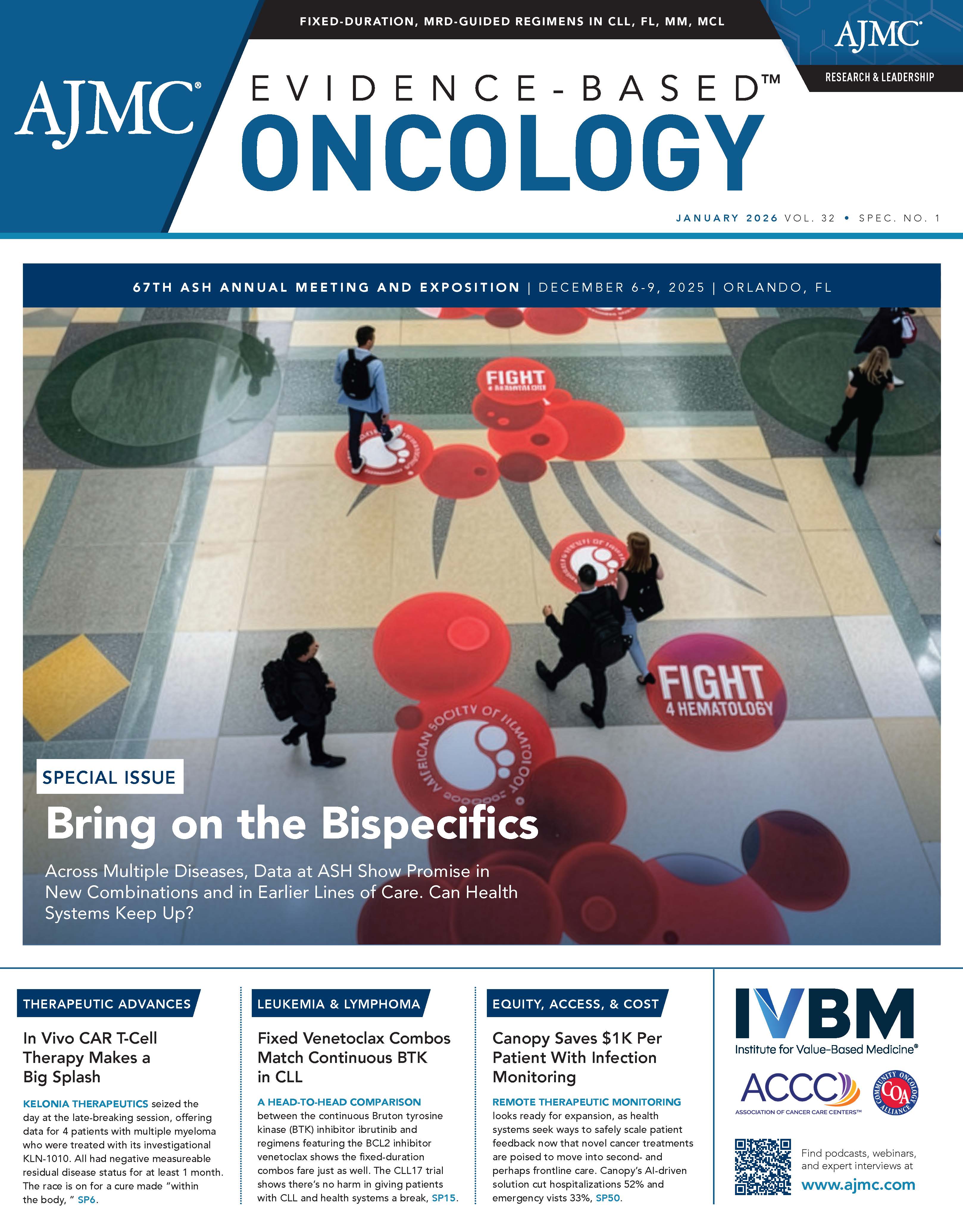
In vivo chimeric antigen receptor (CAR) T-cell therapy is here—sooner than expected—and today, it kicked off the late-breaking session at the 67th American Society of Hematology Annual Meeting & Exposition.1 One audience member said the findings “take your breath away.”
Never mind that only 112 days have passed since the announcement that presenter Phoebe Joy Ho, MBBS, DPhil, professor at the University of Sydney, dosed the first patient with KLN-1010,2 the investigational treatment from Kelonia Therapeutics,3 one of the dozens of players large and small in a billion-dollar quest4,5 to deliver the next generation of one-and-done cancer treatments.


Phoebe Joy Ho, MBBS, DPhil

Ho presented data for 4 patients who have been in measurable residual disease (MRD)–negative status for at least 1 month, with the longest at 5 months. She added week-old results for the last patient beyond what had been announced in an early abstract. The patients, at various points from complete response to early partial response, did not require lymphodepletion and all saw CAR T-cell expansion around day 15. In this phase 1 study, the fourth patient received a reduced dose of 6x10⁶ IU/kg from the first 3 patients, who were treated at 2x10⁷ IU/kg.
“Our study, reported here for the first time today, aims to expand the reach of CAR T cells by in vivo gene delivery using lentiviral particles to achieve in vivo generation of CAR T cells,” Ho said. “As you will see, this eliminates the need for preconditioning, lymphodepletion, chemotherapy, [and] simplifies the logistics, which helps to expand access, and the absence of ex vivo culture may also increase T cell fitness.”
If successful, in vivo CAR T-cell therapy could overcome barriers that put today’s CAR T-cell therapies beyond the reach of many patients: a time-consuming manufacturing process that is expensive and gives cancer time to progress, and a need to stay in the hospital or immediately nearby when the therapy is given, due to fears of adverse events.
For years, there have been reports of both progress and setbacks in “off the shelf” CAR T-cell therapy, but much of this has surrounded allogeneic solutions—those that would involve donor cells, perhaps modified with gene editing. Besides eliminating the wait time, some believe these treatments could be produced at a dramatically lower cost per dose—possibly 5 figures vs the 6-figure sums for CAR T-cell therapy. However, the concern has been that patients would risk the possibility of graft-vs-host disease.
In vivo therapy addresses this problem, Michael Rosenzweig, MD, MS, chief of the Division of Multiple Myeloma, City of Hope, said in an interview with The American Journal of Managed Care®. “With the in vivo technology, patients would not be exposed to a foreign molecule. It's an internal molecule that's made by the patient themselves. And so, the risks of adverse reactions would presumably be lower,” he said.
As reported by Evidence-Based Oncology™ in August,4 there are 2 basic in vivo technologies under development: viral vectors and lipid nanoparticles, which use a delivery platform similar to messenger RNA (mRNA) COVID-19 vaccines. Both eliminate the need to collect T cells from patients, along with subsequent manufacturing and hospital stays.
Kelonia Therapeutics uses a version of the first technology. In her presentation, Ho described KLN-1010 as “replication-incompetent, self-inactivating lentiviral vector with a modified envelope, containing 2 synthetic envelope proteins.”
First, she explained, the detargeted fusogen vesicular stomatitis virus glycoprotein mutation avoids delivery to low-density lipoprotein–expressing cells while maintaining high transduction efficiency. And, precise retargeting to T cells with CD3 scFv, a small, engineered antibody fragment, avoids liver uptake and drug sinks.
“These envelope proteins therefore target CD3+ T cells to enable entry of KLN-1010, delivering a transgene encoding a fully human anti B-cell maturation antigen [BCMA] chimeric antigen receptor…which was selected based on high levels of activity in BCMA-positive tumors, in mouse xenograft models of myeloma.”
It turns out that KLN-1010 delivered in vivo led to “more profound killing” of the tumor compared with ex vivo manufactured cells in treated mice.
The authors call their treatment “an off-the-shelf therapy” that “eliminates the need for apheresis, bespoke ex vivo cell manufacturing, or lymphodepleting chemotherapy.” KLN-1010, they wrote in their early abstract, “may broaden access to CAR-T therapies.”
The phase 1 trial, called inMMyCAR (NCT07075185), is designed to evaluate the safety and tolerability of the therapy and develop a recommended phase 2 dose of KLN-1010 in patients with relapsed or refractory (R/R) multiple myeloma. Ho explained that the study will enroll 20 initial patients, and 20 more in an expansion phase. Patients must have R/R multiple myeloma with measurable disease, adequate end-organ and bone marrow function, and at least 3 prior lines of therapy, including a proteosome inhibitor, an immunomodulatory drug, and an anti-CD38 monoclonal antibody.
Kelonia surprised many with its November 24, 2025, announcement that it would present data from 3 patients dosed with KLN-1010 during ASH’s late-breaking session.3 Several analysts said the small number of patients means that no one should react too strongly to the news, especially after stocks dipped for some companies developing allogeneic CAR T-cell therapeutics.


Michael Rosenzweig, MD, MS | Image: City of Hope

Rosenzweig agreed that balancing the high level of interest with caution is in order. “It’s very early. They’re only reporting on 3 patients, so we still have a lot more to learn,” he said. “But it’s definitely an exciting abstract that's beginning, at least, to offer proof of principle that it’s possible to do this with some efficacy.”
A major outstanding question is whether the therapy is durable, Rosenzweig said. “How long are those CAR T cells that are being made in vivo going to persist and provide excellent disease control?” he asked. “In the first 3 patients, we're seeing great responses early… But how durable are those responses, and how durable are the lack of adverse events? Will we see delayed toxicity, delayed neurotoxicity, or any kind of delayed adverse events?"
A Highly Competitive Landscape
Companies that have joined the in vivo race include the original CAR T players: Novartis, which is working with Vyriad, and Gilead, which acquired Interius BioTherapeutics. Other major pharma companies in the mix include AstraZeneca, which acquired EsoBiotec, and AbbVie, which acquired Capstan Therapeutics and has licensing agreements for Umoja Biopharma projects. Capstan’s mRNA lipid nanoparticle approach is similar to what competitors Orna Therapeutics and Myeloid Therapeutics are using. Kelonia’s competitors on the viral vector side include Umoja and Interius.
When the ZUMA-1 trial for axicabtagene ciloleucel (axi-cel/Yescarta; Kite/Gilead) was presented at ASH in December 2016, attendees were wowed by results that showed 76% of patients with diffuse large B-cell lymphoma (DLBCL) had an objective response after not responding to the last 2 lines of therapy. These were patients who had run out of options. But the good news was offset by reports of significant adverse events, including cytokine release syndrome (CRS). What’s more, making this therapy required harvesting the patient’s T cells and engineering them to find cancer in a process that could take 6 weeks. For some with an aggressive cancer such as DLBCL, CAR T-cell therapy was not an option.


Kevin Friedman, PhD | Image: LinkedIn

“KLN-1010 is beginning to show the extraordinary clinical outcomes that may be possible with in vivo CAR-T therapy—early, deep responses from a single infusion without the barriers that limit access to traditional CAR-T treatments,” Kevin Friedman, PhD, CEO and Kelonia cofounder, said in a statement when the late-breaker status was announced.3
"While still early, the remarkable responses and desirable safety profiles from our off-the-shelf in vivo CAR-T therapy that does not require preparative chemotherapy demonstrates that the democratization of CAR-T therapies may be truly within reach," Friedman said in a statement released this morning. "KLN-1010 is beginning to reveal what may be possible with in vivo CAR-T therapy; deep responses, a differentiated safety profile, and the potential for broad accessibility."6
Authors described the study design as 3+3 dose escalation with half-log dose increments. Results are as follows1:
- The 4 patients range in age from 61 to 72 years, and their time from diagnosis was 7.8 to 9.4 years. All had high-risk cytogenetics and 3 to 5 prior lines of therapy.
- Time from consent to infusion was 13 to 18 days. No lymphodepletion was required.
- Three of 4 were triple-class refractory and all were naive to BCMA-targeted therapies.
- Ho said all patients experienced a rise in lymphocyte count, with 1 patient at the first dose level rising to 43 x109/dL. Dexamethasone was administered to this patient and 1 other with no clinical sequelae.
- CAR T-cell expansion has been consistent with levels seen in today’s available ex vivo therapies. CAR T cells were detected in the bone marrow and peripheral blood through month 3; these were mostly memory-phenotype T cells.
- Among all 4 patients treated, MRD-negative responses (10-5 or 10-6 sensitivity) were seen in all patients at the 1-month mark.
- Ho reported that the toxicity profile was highly favorable to that of ex vivo CAR T-cell therapy; there have been 2 grade 3 cytokine release syndrome events that resolved promptly with dexamethasone and tocilizumab, and 1 grade 4 event (neutropenia). There have been no cases of immune effector cell–associated neurotoxicity syndrome, and no evidence of delayed neurotoxicity.
The authors reported that all patients had achieved a partial response at month 1 by IMWG criteria and that responses deepened over time; the best response has been a complete response by the first patient treated. Responses continue without disease progression.
“KLN-1010 demonstrates that promising clinical activity and manageable toxicities are feasible with an off-the-shelf in vivo CAR-T in MM,” the authors concluded.1
References
- Ho PJ, Harrison S, Talam S, et al. Minimal residual disease (MRD)-negative outcomes following a novel, in vivo gene therapy generating anti-B-cell maturation antigen (BCMA) chimeric antigen receptor (CAR) T cells in patients with relapsed and refractory multiple myeloma (RRMM): preliminary results from inMMyCAR, the first-in-human phase 1 study of KLN-1010. Presented at: 67th American Society of Hematology Annual Meeting & Exposition; December 6-9, 2025; Orlando, FL. Abstract LBA-1.
- Kelonia Therapeutics doses first patient in phase 1 inMMyCAR study evaluating in vivo CAR T-cell therapy for relapsed and refractory multiple myeloma. News release. Kelonia Therapeutics. August 19, 2025. Accessed December 8, 2025. https://keloniatx.com/kelonia-therapeutics-doses-first-patient-in-phase-1-inmmycar-study-evaluating-in-vivo-car-t-cell-therapy-for-relapsed-and-refractory-multiple-myeloma/
- Kelonia Therapeutics announces late-breaking oral presentation of first-in-human data from in vivo BCMA CAR T therapy at the American Society of Hematology (ASH) 2025 annual meeting. News meeting. Kelonia Therapeutics. November 24, 2025. Accessed December 8, 2025. https://keloniatx.com/kelonia-therapeutics-announces-late-breaking-oral-presentation-of-first-in-human-data-from-in-vivo-bcma-car-t-therapy-at-the-american-society-of-hematology-ash-2025-annual-meeting/
- Flinn R. How in vivo CAR T-cell therapies could rewrite the cancer care playbook. Am J Manag Care. 2025;31(Spec. No. 9):SP574-SP576.
- Dolgin E. In vivo CAR T sparks billion-dollar race. Cancer Discovery News. September 9, 2025. doi:10.1158/2159-8290.CD-NW2025-0072
- Kelonia Therapeutics presents first in human data from phase 1 inMMyCAR Study of KLN-1010 in vivo BCMA CAR-T therapy at the American Society of Hematology (ASH) 2025 Annual Meeting. News release. Yahoo Finance. December 9, 2025. https://finance.yahoo.com/news/kelonia-therapeutics-presents-first-human-123000503.html


The Importance of Examining and Preventing Atrial Fibrillation
August 29th 2023At this year’s American Society for Preventive Cardiology Congress on CVD Prevention, Emelia J. Benjamin, MD, ScM, delivered the Honorary Fellow Award Lecture, “The Imperative to Focus on the Prevention of Atrial Fibrillation,” as the recipient of this year’s Honorary Fellow of the American Society for Preventive Cardiology award.
Listen


