

- Center on Health Equity & Access
- Clinical
- Health Care Cost
- Health Care Delivery
- Insurance
- Policy
- Technology
- Value-Based Care
Canopy’s Remote Therapeutic Monitoring Cuts Infection-Related Hospitalizations by Half in Patients With Blood Cancers
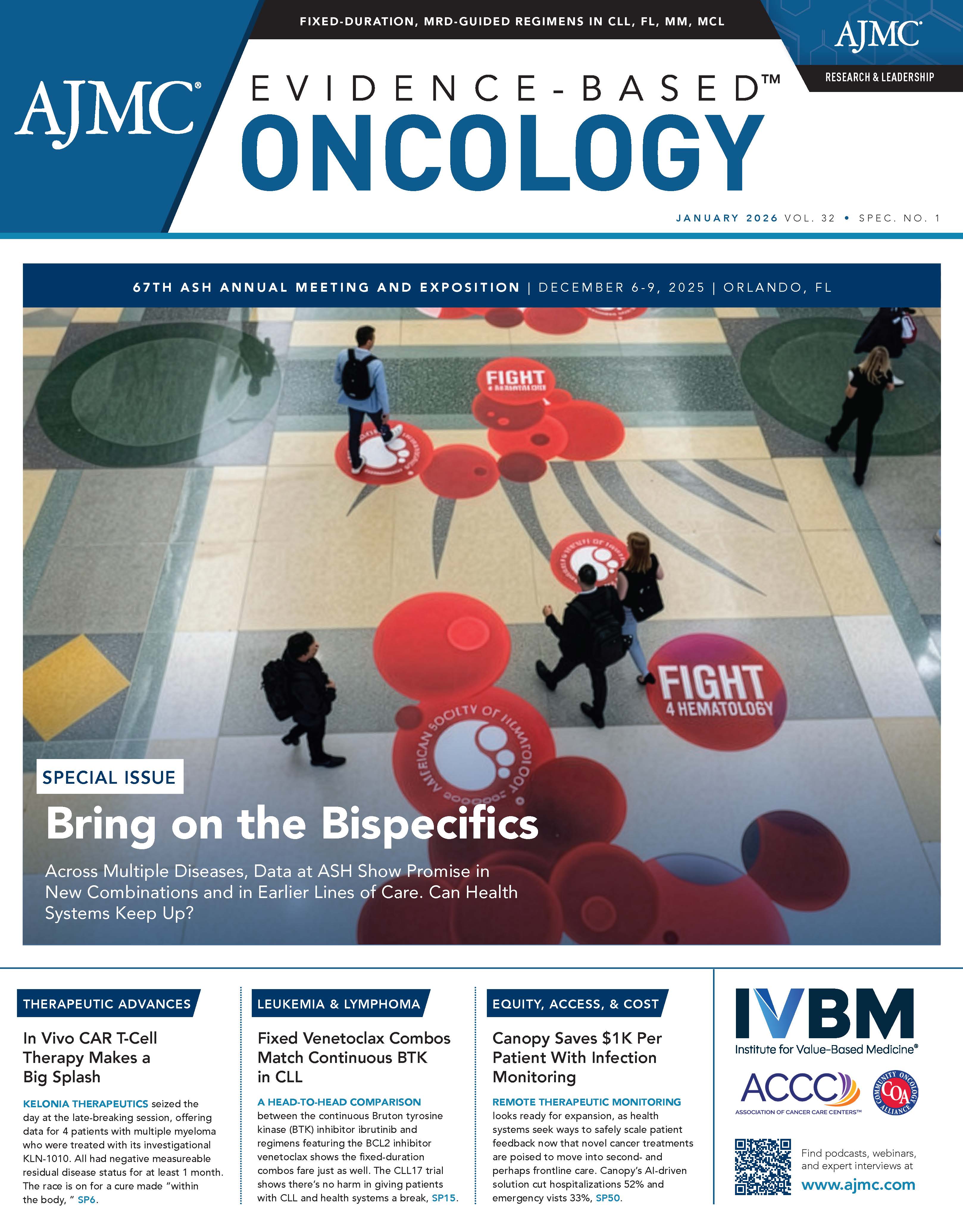
Remote therapeutic monitoring (RTM) of patients with blood cancers cut hospitalizations from infections by 52% over 2 years compared with patients not enrolled in monitoring, according to data presented during the recent 67th American Society of Hematology (ASH) Annual Meeting & Exposition in Orlando, Florida.1
That dramatic reduction means the remote monitoring system, developed by Canopy, generates savings that translate into $977,695 annually per 1000 patients, based on national benchmarks.2 And that’s the kind of savings that can make it worthwhile for a community practice to adopt RTM, which will have increased flexibility for Medicare reimbursement in 2026.3
Patients in the study presented at ASH were given the option to take part in Canopy RTM while receiving therapy for a variety of hematologic disorders, the most common being non-Hodgkin lymphoma, multiple myeloma, and chronic lymphocytic leukemia.1 While new therapies to treat these conditions have significantly extended survival, some of these therapies can cause adverse events, including infections and cytokine release syndrome (CRS).
The results have significant implications for managed care, as novel therapies such as bispecific antibodies appear poised to reach many more patients. At present, in myeloma, for example, these treatments are limited to patients in later lines of care. However, data presented in Orlando at ASH suggest bispecific antibodies could soon be used to treat patients at their first relapse, perhaps in combination with anti-CD38 therapies,4 or even as monotherapy for newly diagnosed patients.5


Lavi Kwiatkowsky | Image: LinkedIn

Scaling bispecific therapies to that degree simply isn’t possible without some type of monitoring strategy that involves technology, specifically artificial intelligence (AI), Canopy Founder and CEO Lavi Kwiatkowsky said in an interview with The American Journal of Managed Care (AJMC).
“What are practices doing today? They’re calling every patient every 3 hours or every 6 hours,” Kwiatkowsky said. “Now, if it’s once in 6 hours, it’s not as safe. If it’s once in 3 hours, it’s just not scalable, and they won’t be able to do it.”
Community oncology practice administrators have told AJMC that they agree—there simply aren’t enough staff available for this work, and if they were available, it would cost too much. Instead, Canopy’s use of AI-based electronic patient-reported outcomes (ePROs) to alert nurses about patients at risk of hospitalization makes sense.
The study, titled “Remote Therapeutic Monitoring Reduces Hospitalization Due to Infection in Patients Being Treated for Hematological Malignancy,” was designed to learn whether Canopy’s RTM system could prompt early intervention and treatment of infections, thus allowing patients to avoid emergency care and hospitalizations. The study was led by James Essell, MD, medical director for the Center for Cancer and Cellular Therapy at Oncology Hematology Care and The Jewish Hospital, and chair for cellular therapy at Sarah Cannon Research Institute.1,2
Study Design and Methods
The research examined patients treated at Highlands Oncology Group, a community oncology practice in Arkansas. Over a 2-year period following the first anticancer treatment, 349 patients voluntarily enrolled and submitted RTM reports within 30 days of starting treatment, while 1296 patients received treatment without enrollment.1
The RTM system allowed patients to self-report symptoms through ePROs. A dedicated triage nursing staff monitored these reports, and symptoms exceeding predetermined severity thresholds triggered evaluation for telephonic triage, urgent outpatient office visits, or emergency department referrals. The researchers used inverse probability of treatment weighting to account for potential selection bias in patients who chose to enroll.1
Monitoring Leads to Early Intervention
The results revealed that patients using ePRO were less likely to experience encounters with the hospital related to infections. Specifically, results showed the following1:
- RTM patients had a 52% reduction in infection-related inpatient stays (2.6% vs 4.5%; weighted P = .0147; RR, 0.48; 95% CI, 0.24-0.96).
- The RTM patients had 33% fewer infection-related emergency department visits (6.6% vs 9.4%; weighted P = .047; RR, 0.72; 95% CI, 0.45-1.15).
- In addition, RTM patients received significantly more oral antibiotics (38% vs 29%; P < .0125). This 20% uptick in the likelihood of receiving outpatient antibiotics suggests that earlier intervention may prevent infections from escalating to the point of requiring acute care.
The study also uncovered critical timing patterns: 70% of patients with an infection-related acute event and 77% of those receiving outpatient antibiotic orders had self-reported symptoms in the preceding 30 days. Several symptoms appeared more frequently within 15 days before acute care events or antibiotic orders, underscoring opportunities for earlier clinical intervention.1


James Essell, MD | Image: OHC

“What stands out in this study is how often patients with hematologic malignancies reported symptoms before an acute event,” Essell said in a statement.2 “Those reports frequently preceded the need for infection-related outpatient antibiotics, suggesting that earlier symptom visibility may help clinicians address issues before they escalate into acute events and higher-cost care.”
Economic Impact
The reduced acute-care utilization translated into substantial cost savings of $977,695 annually per 1000 patients, based on national Agency for Healthcare Research and Quality benchmarks.2 Kwiatkowsky emphasized the financial implications: “You can say in the same sentence with RTM, there’s RTM billing [through Medicare], but the investigators here are showing that even in just 1 cause of hospitalization, that alone covers the annual cost of [RTM].”
In the interview, he explained that the investment in remote monitoring offers tremendous value: “If you get the savings of close to $1000 a patient, just for the infections, you’ve also [received] the RTM to monitor for CRS and all the other things that you have to be looking for free, practically.”
Implications for Emerging Therapies
The timing of this research is particularly significant as novel immunotherapies with unique infection risks continue to expand in hematologic malignancies. “These results reinforce the value of having greater insight into patients’ symptoms when they are away from the clinic,” Essell noted in the statement. “The added visibility [that RTM] provides will matter even more as novel therapies with unique toxicities and infection risks continue to expand, such as bispecific T-cell engagers and [chimeric antigen receptor] T-cell therapies.”2
Building on Previous Evidence
This study adds to growing evidence supporting Canopy’s RTM platform, including previous findings that demonstrate a greater likelihood of patients with both lymphoid malignancies and multiple myeloma reporting symptoms promptly and frequently.6,7
Kwiatkowsky explained the unique contribution of this study. “We put a twist on it,” he said. “We’re showing you the whole trajectory. We monitored and found more symptoms. [Patients] got antibiotics, and they went to the hospital less.”
Over the years, studies that demonstrate the value of symptom monitoring have not had the impact they deserved,8,9 but Kwiatkowsky said showing the entire patient journey makes this study stand apart. “They got treatment; they didn’t go to the hospital. And so that’s what’s special about it. It’s the first [time] ever that someone is double-clicking into a cause of improvement thanks to remote monitoring.”
References
- Essell J, Ascha M, Schaefer E, et al.Remote therapeutic monitoring reduces hospitalization due to infection in patients being treated for hematological malignancy. Presented at: 67th American Society of Hematology Annual Meeting & Exposition; December 6-9, 2025; Orlando, FL. Abstract 131.
- Oral presentation at ASH 2025 shows Canopy RTM cuts infection-related hospitalizations by 52% and generates nearly $1M in annual savings per 1,000 patients. News release. Canopy. December 9, 2025. Accessed December 16, 2025. https://www.prnewswire.com/news-releases/oral-presentation-at-ash-2025-shows-canopy-rtm-cuts-infection-related-hospitalizations-by-52-and-generates-nearly-1m-in-annual-savings-per-1-000-patients-302635975.html
- Calendar Year (CY) 2026 Medicare Physician Fee Schedule Final Rule (CMS-1832-F). CMS. October 31, 2025. Accessed December 16, 2025. https://www.cms.gov/newsroom/fact-sheets/calendar-year-cy-2026-medicare-physician-fee-schedule-final-rule-cms-1832-f
- Mateos MV, Bahlis N, Perrot A, et al. Phase 3 randomized study of teclistamab plus daratumumab versus investigator’s choice of daratumumab and dexamethasone with either pomalidomide or bortezomib (DPd or DVd) in patients with relapsed refractory multiple myeloma (RRMM): results of MajesTEC-3. Presented at: 67th American Society of Hematology Annual Meeting & Exposition; December 6-9, 2025; Orlando, FL. Abstract LBA-6.
- Orlowski RK, Shah MR, Chakraborty R, et al. Safety and efficacy of linvoseltamab as a simplified monotherapy first-line regimen in NDMM: initial results from the window of opportunity phase 1/2 LINKER-MM4 trial. Presented at: 67th American Society of Hematology Annual Meeting & Exposition; December 6-9, 2025; Orlando, FL. Paper 697.
- Essell JH, Derman BA, Kolodziej MA, et al. Symptoms detection among patients with lymphoid malignancies (LM) using electronic patient-reported outcomes (ePROs) in community hematology-oncology clinics. Presented at: 66th American Society of Hematology Annual Meeting & Exposition; December 7-10, 2024; San Diego, CA. Abstract 3756.
- Derman BA, Essell JH, Kolodziej MA, et al. Electronic patient-reported outcome (ePRO) symptom monitoring for relapsed/refractory multiple myeloma in community settings, focusing on bispecific antibody therapy. Presented at: 66th American Society of Hematology Annual Meeting & Exposition; December 7-10, 2024; San Diego, CA.
- Basch E, Deal AM, Dueck AC, et al. Overall survival results of a trial assessing patient-reported outcomes for symptom monitoring during routine cancer treatment. JAMA. 2017;318(2):197-198. doi:10.1001/jama.2017.7156.
- Basch E, Schrag D, Henson S, et al. Effect of electronic symptom monitoring on patient-reported outcomes among patients with metastatic cancer: a randomized clinical trial. JAMA. 2022;327(24):2413-2422. doi: 10.1001/jama.2022.9265.


Empowering Children and Parents Through Technology: Opportunities, Challenges, and Future Directions
January 15th 2026Digital health platforms improve pediatric care by offering customized, interactive tools for children and parents. They enhance education, support, and engagement while tackling challenges related to access, usability, and privacy.
Read More


Insights Into Patient Portal Engagement Leveraging Observational Electronic Health Data
January 12th 2026This analysis of more than 250,000 adults at least 50 years old with chronic conditions showed lower portal use among older, non–English-speaking, and Black patients, underscoring digital health equity gaps.
Read More

