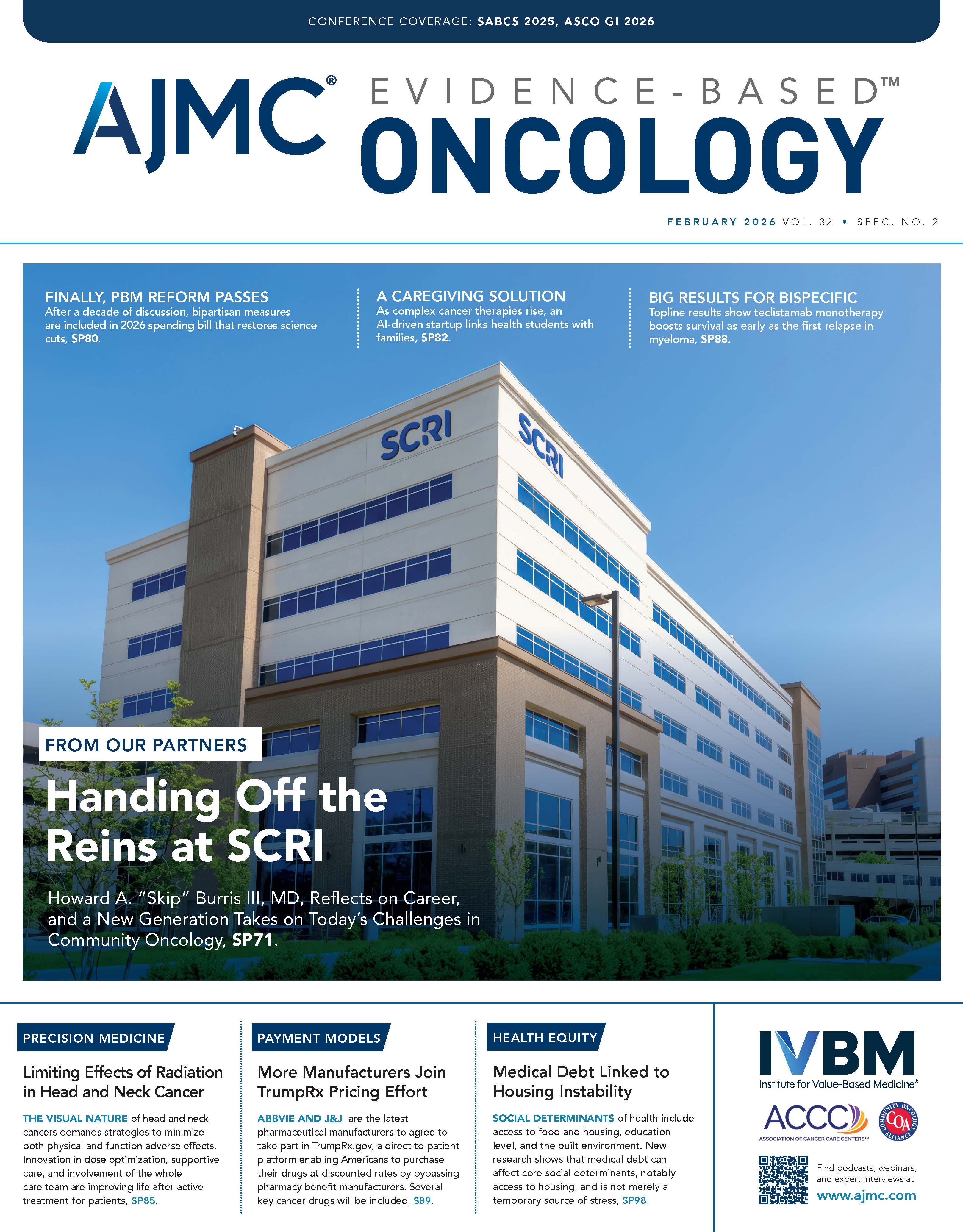
Following an interest in medicine that first surfaced in high school, Howard A. “Skip” Burris, III, MD, went on to have a decades-long storied career in oncology. After graduating from the US Military Academy at West Point, Burris was inspired by mentors from his younger years through the academy about the personal aspect of medicine. His time in medical school served as the foundation for a patient-centered philosophy that would be built on kindness and service to veterans.
What SCRI Leaders Say About Howard A. “Skip” Burris, III, MD
“I’ve known Skip Burris for 22 years. He’s been a mentor and a role
model. Skip is brilliant—he understands cancer research and drug development—but as accomplished as he is, what I’ve learned most from Skip is the value of relationships and listening. He is so beloved by his patients and their families, not just because he’s smart and internationally known, but because he takes the time to understand them—what’s important to them, what’s going on with their families. If you’ve ever been with Skip when he is with one of his patients, he will talk about everything other than cancer… He gives his phone number out to everybody. He’s accessible; he’s available 24/7. I’ve been fortunate enough to learn some of those things early on, and to try to emulate those characteristics in how I care for patients, and, of course, in the relationships we develop with our biotech and academic partners. That’s helped Sarah Cannon get to where we are today.”
—David R. Spigel, MD,
president and chief medical officer,
Sarah Cannon Research Institute
“Dr Skip Burris changed the arc of early phase research by moving phase 1 trials into the communities where patients live. Under his leadership at SCRI, we have conducted more than 850 first in human clinical trials, translating discovery into access, and access into outcomes. From ASCO leadership to the everyday work of opening trials closer to home, Skip turned early phase research into a bridge from discovery to hope. His legacy is measured in therapies, teams, collaborations, and, most importantly, patients who received novel options because he believed community oncology could lead. That vision continues to guide us as we bring innovation closer to those who need it most.”
—Vivek Subbiah, MD,
chief, early phase drug development,
Sarah Cannon Research Institute
“I could spend a whole hour talking about lessons we’ve learned from
Dr Burris…. One of the lessons I’ve learned from him is that innovation only matters if it improves care for patients in the real world. He always pushed us to think bigger, but also to execute. So, he believed deeply in bringing research to the community and demanding excellence—and never accepting that that’s how it’s always been done. Clinical research can only be done in an academic center. Well, why? Why can’t we do that in smaller cities, in community practice. And so, as I move into this role, I carry forward that mindset: be ambitious, be disciplined, stay focused on impact. And that really means advancing development strategies that are practical, that are scalable, and that ultimately serve our patients where they live.”
—Erika P. Hamilton, MD,
chief development officer, late phase;
director, breast cancer research
Sarah Cannon Research Institute
“Skip has taught me so much over the years…. Most of all, I think he taught me the importance of relationships. He knows everybody, and that’s not just because he’s a chatty guy. He understands how important it is to be able to call someone by name, to be able to remember the personal details about them, and that that will help grease the skids for the next conversation that you’re going to have. Oncology research is all about relationships; we see pharma and biotech leaders come and go, but Skip taught us to look for the leaders in and follow them as they go from company to company. He also really taught the group here in Nashville to think bigger and broader—as the director of lung cancer research, it was really easy for me to think about lung cancer all day, every day, and to look at the world in that lens. But of course, that’s a very narrow lens, and there are a lot of other ways to understand the world of drug development, just for one example, and Skip was always asking us to be outside of ourselves, to think about to take a broader view to problems, and to find solutions. I’ll remember and take that with me. And then he was the “he for she.” That’s not an expression we use that much anymore…. Dee Anna Smith, our CEO, said it best: He was always understanding of life balance, and about the other roles that one plays outside of the workplace; he understood that that made us whole. Not all employers and bosses are as open minded and generous as Skip is. So, I hope I take that with me as well as I mentor young physicians.”
—Melissa L. Johnson, MD,
chief scientific officer; director, lung cancer research
Sarah Cannon Research Institute
He was awarded a Meritorious Service Medal for Operation Joint Endeavor during his residency and fellowship in hematology/oncology at Brooke Army Medical Center, where he also served as director of clinical research and associate professor at The University of Texas Health Science Center at Houston. That was followed by what some may consider his greatest legacy:
In 1997, he helped launch the Sarah Cannon Research Institute’s first community-based phase 1 drug development program. Throughout his visionary leadership as president and chief medical officer (CMO), he oversaw more than 850 first-in-human trials, leading to numerous FDA-approved therapies that transformed global standards for cancer treatment.
Burris is a former American Society of Clinical Oncology (ASCO) president and is the current chair of Conquer Cancer, the ASCO Foundation. Bristol Myers Squibb recently recognized his years of service by naming its endowed young investigator award in his honor. As he transitions into part-time retirement, he will continue in an advisory role at Sarah Cannon, working with Accelero, its clinical trials operations arm, and supporting biopharma partner relationships. He passes the leadership baton to David R. Spigel, MD, president and CMO; Melissa L. Johnson, MD, chief scientific officer; Erika P. Hamilton, MD, FASCO, chief development officer, late phase; and Vivek Subbiah, MD, who will continue as chief, early-phase drug development.
Here, Burris urges young physicians to never lose sight of personal connectivity. In an interview with Evidence-Based Oncology (EBO), he reflects on a career that he said is defined by “kindness, compassion, and gratitude,” and on the responsibility to protect public trust and evidence-based medicine.
This interview has been lightly edited for clarity and conciseness.
EBO: What first inspired you to pursue a career in medicine?
Burris: It’s interesting. Most people head to the science piece, but I will go to the people side. When I was in high school, I had several friends whose fathers were physicians. I asked to round with them and visit with them, and became really intrigued by the idea of being a physician. I didn’t have any physicians in my family. Then, when I went off to West Point, I went for a lot of reasons: great college, the opportunity, all the pieces. But when I got there, you are assigned mentors and sponsors, and mine were in the medical field, which was another step in the direction of doing something to help others.
At first, I thought by going to West Point, I wouldn’t be able to go into medicine right away; I would do service first. But actually, while I was there—another sign from above—they decided to let a select number of individuals each year go to medical school, and I was chosen for that program and was able to get in. All of the stars started going in that direction. But I like the people, the service. The personal aspect of it attracted me far more than burning scientific interest.
EBO: When you look back on your decades of oncology leadership, what does it mean to have an award carry your name?
Burris: It was a great honor—it was a surprise. Members of my family were in the military, I was in the Army, so being tied to an award that was going to be funding and inspiring others to do work to help veterans with cancer in the military was special. Being tied to the American Society of Clinical Oncology was important. ASCO has been a big part of my oncology career—so that was a nice piece. It’s an endowed award, so it will live on for generations. We’re going to have a family of doctors, as an awardee gets named every year. They will be part of this family that will be my Bristol Myers Squibb–Burris family of young investigators who are studying veteran cancer. And then Bristol Myers Squibb is one of the premier pharmaceutical companies. It was one of the companies that gave me some of my earliest opportunities in clinical research, and 30, 35 years later, they were the ones who stepped forward to make it happen. Everything about it turned out to be just perfect. ASCO, the right pharmaceutical company, the veteran piece of it. It was all very, very special. Probably wouldn’t have thought of having the one that I felt was so special to me to be named in my honor.
EBO: How did the lessons you learned caring for veterans shape who you wanted to be as a physician, or is it that who you wanted to be as a physician shaped how you cared for veterans?
Burris: I have a sign that was by my ledge for many, many years as a physician, which simply stated, “Be kind to the person you’re talking to, because you have no idea what battles they’re currently going through.” I think training in the military was a special opportunity. The folks that you are taking care of and their family members had all given of themselves for the country and provided that service. The vast majority had been through a variety of situations, whether they’d been in conflict or whether they had been dragging their family around the US or the world, or all the life bumps that they’ve been through. It was a different group of patients to take care of—they all were out there, and often from very diverse backgrounds and geographies and where they grew up. They were special in that regard.
I think they also were such a unique group of grateful and respectful people. They were grateful to have medical care, grateful to have somebody who cared about them and to be cared for by somebody who had also chosen medicine and was in a field of service. Training in a military center and taking care of veterans and active-duty military really is a very special place to practice. It really fundamentally grounds you in the whole idea of caring about those you’re taking care of, and they care about you.
EBO: Looking at what Sarah Cannon has grown into, what advice would you give to your younger self at the very beginning?
Burris: As I think back, I have no regrets. I would have done it all over again. I think, for myself and maybe for the great team and staff I had with me, I probably would tell myself to be a little more patient and a little more tolerant. I was always in a bit of a hurry and maybe could have enjoyed a little bit more earlier. But I will say that the people who we did it with, that core group of individuals who helped launch it with me, stayed with me for a long time. They’re the ones who really made it happen. I take pride in the fact that we always simply did the right thing. We didn’t take any shortcuts. We didn’t do it for the money. We didn’t do it to be famous. The whole idea was getting patients access to drugs and getting them to them earlier. The patients were grateful; the staff were grateful. It just all gelled together very nicely. But to end with where I started, it never hurts to be a little more patient and a little more tolerant of the folks around you and life’s ups and downs.
EBO: You’ve certainly had an impact on countless colleagues and patients throughout your career. Who has influenced you most, and who would you like to thank as you reflect on this moment?
Burris: I’m passing the baton of leadership here to some great physicians. That’s a key part of this next phase of my life. It’s the right time for these people that I’ve been a mentor to and have helped train to take over. My wife, Karen, just trusted me and believed in me, and was 100% supportive of what I wanted to do and the move I made and the hours I put in. I was so fortunate.
I’m a little bit of a fate person. When I went to San Antonio for training, one of the first attendings that I ran into was Dan Von Hoff, MD, FACP. He was a famous drug developer, and really was the one who got me hooked on the idea of clinical research and the fact that we needed better therapies. He was somebody who delegated, passed the baton, gave me responsibility, pushed me to be on stage, pushed me to be an author, to be a leader. One of those folks who didn’t need all the credit. He really took great pride in those of us who worked for him, and so him pushing me forward was the first step in my career in oncology. I’ll always be grateful to him.
I’ll mention 2 other folks. Tony Greco, MD, who is one of the founders of Sarah Cannon, I met in the early ’90s, and he stayed in touch. He was the one who recruited me to Nashville as he was attempting to build this first program in the community and wanted somebody to come lead the investigational drug part of it. Then our CEO, Dee Anna Smith, who was a great partner. Dee Anna taught me a lot about being a business leader, about being a leader of people you know. She was a person who helped me sort of round out the whole executive physician package that I so much wanted to be.
EBO: Five years ago, you spoke about the high-quality work that is going on in both the US and around the world. Today, as evidence-based medicine faces increased skepticism, what are your thoughts on the responsibility that scientific and medical leaders have to protect progress and public trust?
Burris: I think it’s something that we can’t shy away from. It’s something that we need to embrace. The ultimate end of all of this work and this effort is the patient who’s going to benefit. We’ve got to keep what’s best for the patient at the center of all that we do. There’s economic pressures and time pressures, there’s every opportunity to take a shortcut. It is something where we’re in a place where patients need to be afforded the best opportunity that they can to get the right medicines and the right treatment, and so conducting the clinical research, publishing the results, moving things along, never settling for second.
I do believe that we underestimate the trust that the population and the individual patients put in us as doctors and scientific leaders. There’s a lot of noise right now in the world about what’s right or wrong about how we do health care, and it’s just so important that if you don’t have good health, you don’t have anything. It’s a cliché, but it’s true. It’s one of the most important things we have in our life. The population really does count on the physicians and scientific leaders to make sure that we’ve got the best that we can offer being pushed forward.
EBO: What do you hope young physicians entering medicine never lose sight of?
Burris: We’re inundated with data. We’ve got all the information that we’ve wanted. It’s coming forward. There is artificial intelligence, everything’s so automated now, electronics and technology and the like. I think we can’t lose the human nature aspect of it. At the end of the day, this is a people business. That person still wants that connectivity. I encourage our physicians to know their patients. They have a life outside of their visit, and often that insight into their life is really a key to helping them achieve what they want to achieve with their health care, particularly in the field of cancer. That patient also is putting a lot of trust in you, so just encouraging them. In all the science and all the information that we’re having nowadays, keep that person front and center that you’re taking care of. It’s one patient at a time.
You’ve also got to love what you do, and you’ve got to love the people you’re going to do it with. You’re going to spend so much time at work. I was fortunate to be pointed in the direction of cancer and to have a career in cancer, but it’s worked out for me largely because I do love being with the cancer patients and I do love being with the oncologists. Every medical specialist has got their own feel and culture to it, and I ended up getting to hang out with the right people.
EBO: What 3 words would you use to sum up your career?
Burris: Kindness. Compassion. Gratitude.
Reference
Shaw ML. Access to care: Burris says united with our patients, we accelerate progress together. Am J Manag Care. 2020;26(spec 6):SP179.