- Center on Health Equity & Access
- Clinical
- Health Care Cost
- Health Care Delivery
- Insurance
- Policy
- Technology
- Value-Based Care
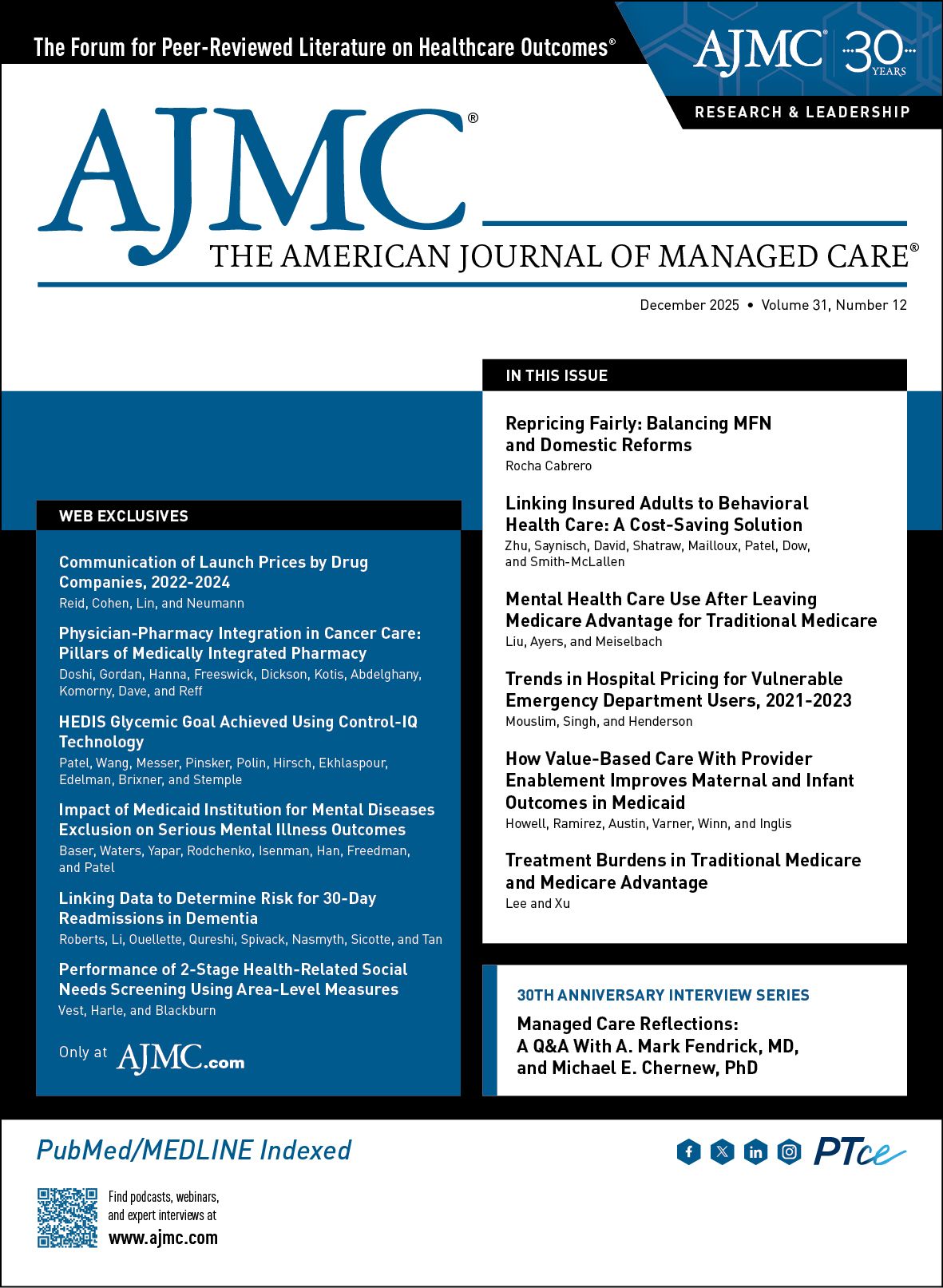
Repricing Fairly: Balancing MFN and Domestic Reforms
This commentary proposes a hybrid drug pricing reform model balancing most favored nation (MFN) benchmarking with domestic negotiation strategies that drive equity-focused valuation frameworks.
ABSTRACT
US prescription drug costs remain the highest globally, prompting proposals such as the most-favored-nation (MFN) pricing model, which benchmarks US drug prices to those of peer nations. In contrast, domestic market-based reforms focus on internal negotiation, competition, and transparency. Although MFN promises rapid cost reductions, it risks innovation disincentives and access delays. This commentary argues for a hybrid policy approach that combines the efficiency of MFN with domestic reforms, guided by equity-focused valuation frameworks such as Generalized Risk-Adjusted Cost-Effectiveness and severity-adjusted willingness-to-pay. A balanced model can achieve affordability without undermining innovation or equity.
Am J Manag Care. 2025;31(12):749-750. https://doi.org/10.37765/ajmc.2025.89833
Takeaway Points
This article outlines a blended drug pricing reform strategy that combines international benchmarking (most favored nation [MFN]) with domestic market-based negotiations to reduce costs while safeguarding innovation and value-based care. Components include the following:
- Apply MFN selectively for high-cost drugs with limited competition to achieve immediate savings.
- Leverage domestic negotiations and rebates to ensure flexible, sustainable price control tailored to complex health care systems.
- Adopt equity-based valuation frameworks (Generalized Risk-Adjusted Cost-Effectiveness, severity-adjusted willingness-to-pay) to prioritize treatments for special and vulnerable populations.
- Promote transparency in pricing and policy advocacy to mitigate industry-driven cost inflation.
The most favored nation (MFN) model would peg high US drug prices to the lowest among peer high-income nations.1 Proponents within the current federal administration2 highlight its potential to reduce costs rapidly, but systemic trade-offs exist. For instance, countries used for benchmarking often delay drug approvals as part of price negotiations. If the US adopts these timelines, it could delay access to novel therapies. Additionally, MFN compresses global pricing margins, which could disincentivize pharmaceutical investment in breakthrough therapies, especially in orphan drugs and underserved therapeutic areas.
Conversely, domestic market-based reforms—such as Medicare negotiation, inflation rebates, out-of-pocket caps, and measures promoting generics and biosimilars3—restructure pricing through internal market levers. Early implementation of Medicare negotiations has achieved price reductions of 38% to 79% for select high-cost drugs, underscoring the potential of domestic levers. These reforms emphasize phased implementation and better alignment with US health care delivery, mitigating the access delays and innovation risks posed by MFN. However, domestic reforms require complex regulatory action and sustained political will (Table 1).
Embedding Equity in Valuation and Cost-Effectiveness
Traditional cost-effectiveness models, especially those based on quality-adjusted life-years, often devalue treatments for people with chronic disabilities, severe illness, or limited life expectancy.4,5 These methods inadvertently bias resource allocation against marginalized populations. The Generalized Risk-Adjusted Cost-Effectiveness (GRACE)6 and severity-adjusted willingness-to-pay (WTP) frameworks offer more inclusive metrics, adjusting value thresholds based on clinical severity, socioeconomic disadvantage, and population-specific factors.5,6 These value-based pricing approaches help rectify structural health inequities by assigning higher value to interventions that benefit historically underserved populations (Table 2).
Industry Influence: Transparency as a Policy Safeguard
Pharmaceutical industry stakeholders heavily influence the policy discourse on drug pricing reforms. Advocacy groups opposing drug pricing reform often receive significant funding from manufacturers and trade organizations. Tactics such as patent evergreening, pay-for-delay agreements, and opaque pharmacy benefit manager rebate structures further entrench inflated drug pricing.1,7 Although these groups raise legitimate concerns about innovation and access,8 these narratives frequently align with profit-driven motives rather than patient-centered outcomes. Policy integrity demands rigorous transparency in funding disclosures for all organizations participating in health policy debates. Ensuring open acknowledgment of commercial interests can help separate genuine equity concerns from industry-influenced messaging.
Toward a Hybrid Drug Pricing Reform Framework
Rather than positioning MFN and domestic pricing strategies as mutually exclusive, policy makers should consider a multimodal approach. MFN benchmarking could be applied selectively to high-cost drugs lacking competition, and domestic tools—rebates, price negotiation with manufacturers, and caps—can promote long-term cost containment strategies. Cost savings from MFN could be reinvested to subsidize research and development8 for therapies addressing unmet clinical needs and limit anticompetitive practices; this requires political will, consistent regulatory enforcement, and buy-in from bipartisan policy makers. Embedding GRACE and WTP principles across this hybrid system offers a way to balance efficiency with fair value.
Conclusions
The path to sustainable drug pricing reform does not lie in choosing between MFN and domestic strategies—it lies in blending their strengths while addressing their shortcomings. A hybrid model guided by equity-conscious valuation tools can deliver affordable medications, maintain incentives for innovation, and reduce systemic disparities. Health policy cannot rely on imported benchmarks or legacy cost-effectiveness tools alone; it must evolve with frameworks that align economic rationality with ethical responsibility. Reduction of spending while preserving access and innovation should be a shared goal of public policy officials and their constituents.
Author Affiliation: Neurology Department, Harbor-UCLA Medical Center, Torrance, CA.
Source of Funding: None.
Author Disclosures: The author reports no relationship or financial interest with any entity that would pose a conflict of interest with the subject matter of this article.
Authorship Information: Concept and design; acquisition of data; analysis and interpretation of data; drafting of the manuscript; critical revision of the manuscript for important intellectual content; and administrative, technical, or logistic support.
Address Correspondence to: Franklyn Rocha Cabrero, MD, Neurology Department, Harbor-UCLA Medical Center, 1000 W Carson St, Torrance, CA 90509. Email: FRochaCabrero@dhs.lacounty.gov.
REFERENCES
1. Kesselheim AS, Avorn J, Sarpatwari A. The high cost of prescription drugs in the United States: origins and prospects for reform. JAMA. 2016;316(8):858-871. doi:10.1001/jama.2016.11237
2. Delivering most favored nation prescription drug pricing to American patients. Fed Regist. 2025;90(93):20749-20751. Executive order 14297. Accessed May 15, 2025. https://www.govinfo.gov/content/pkg/FR-2025-05-15/pdf/2025-08876.pdf
3. Rocha-Cabrero F. You choose: food or medications? MedPage Today. April 23, 2023. Accessed July 16, 2025. https://www.medpagetoday.com/opinion/second-opinions/104149
4. Neumann PJ, Cohen JT. QALYs in 2018—advantages and concerns. JAMA. 2018;319(24):2473-2474. doi:10.1001/jama.2018.6072
5. Neumann PJ, Ollendorf DA, Cohen JT. Value-based drug pricing in the Biden era: opportunities and prospects. Health Serv Res. 2021;56(6):1093-1099. doi:10.1111/1475-6773.13686
6. Lakdawalla DN, Doctor JN. A principled approach to non-discrimination in cost-effectiveness. Eur J Health Econ. 2024;25(8):1393-1416. doi:10.1007/s10198-023-01659-7
7. Hughes S, Rapfogel N. Following the money: untangling U.S. prescription drug financing. Center for American Progress. October 12, 2023. Accessed May 19, 2025. https://www.americanprogress.org/article/following-the-money-untangling-u-s-prescription-drug-financing/
8. Wouters OJ, McKee M, Luyten J. Estimated research and development investment needed to bring a new medicine to market, 2009-2018. JAMA. 2020;323(9):844-853. doi:10.1001/jama.2020.1166