

- Center on Health Equity & Access
- Clinical
- Health Care Cost
- Health Care Delivery
- Insurance
- Policy
- Technology
- Value-Based Care
Tildrakizumab Shows Long-Term Psoriasis Control for Hard-to-Treat Areas
Tildrakizumab at 100-mg and 200-mg doses showed long-term effectiveness for managing psoriasis in challenging areas in a real-world study.
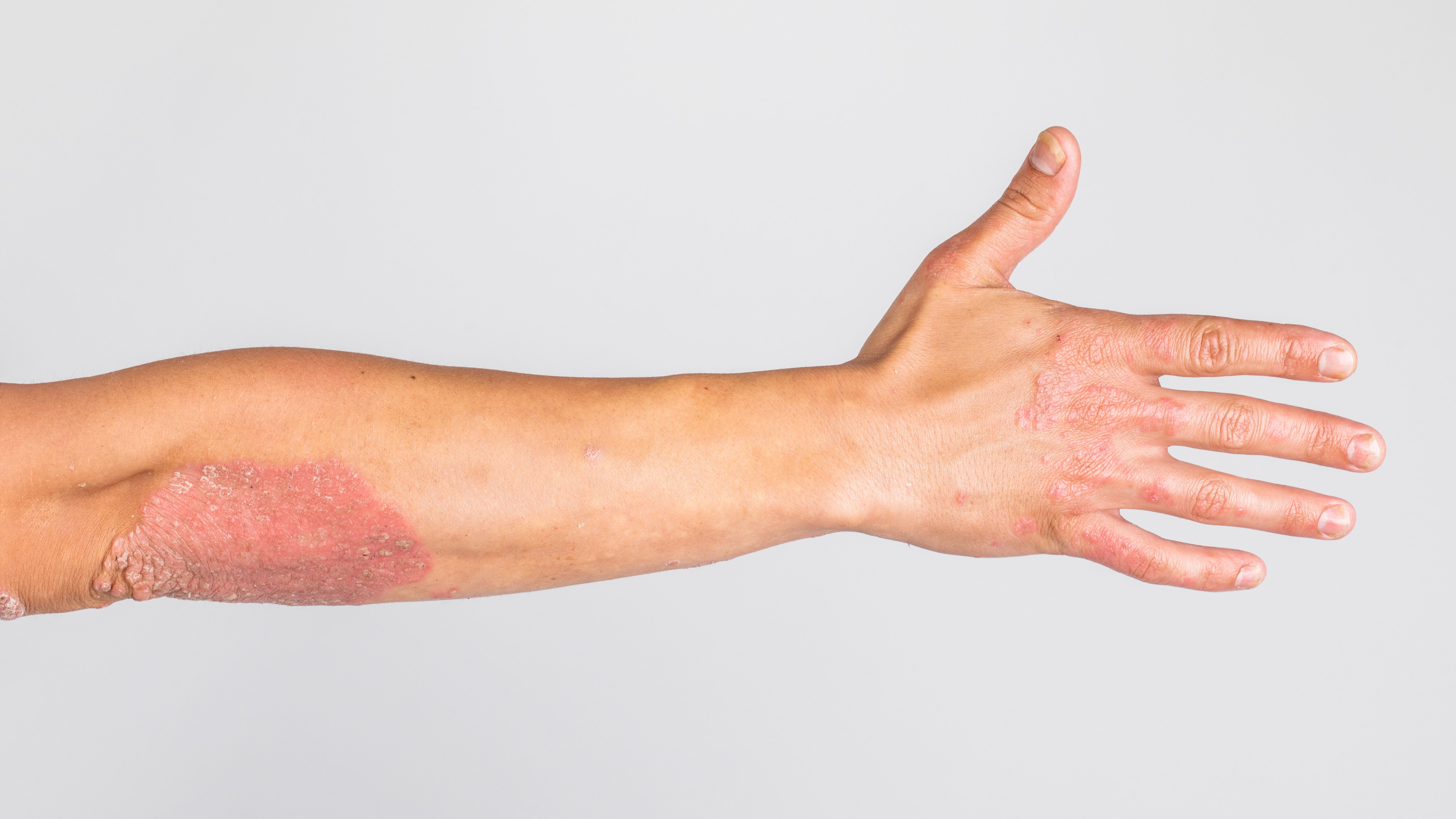
Tildrakizumab (Ilumya; Sun Pharma) demonstrated sustained disease control in a real-world cohort of patients with moderate-to-severe psoriasis affecting difficult-to-treat anatomical areas, including the scalp, genital region, nails, and palmoplantar surfaces—sites often associated with higher symptom burden and poorer treatment response, according to a recent study.1


The findings underscore the potential role of tildrakizumab as a long-term option for patients with psoriasis involving difficult-to-treat areas. | Image credit: fusssergei - stock.adobe.com
The retrospective analysis, published in the Journal of Clinical Medicine, supports the use of tildrakizumab, an interleukin-23 (IL-23) inhibitor that was FDA approved in 2018 for moderate-to-severe plaque psoriasis management,2 in clinical practice.
“Topical treatments are the first-line option for localized psoriasis; however, their effectiveness in difficult-to-treat areas is frequently limited by poor penetration, local irritation, and suboptimal adherence,” the authors wrote.1 “Conventional systemic therapies can also be inadequate or poorly tolerated in these patients. Consequently, biologic agents targeting key inflammatory pathways play a central role in the management of moderate-to-severe psoriasis, including cases with predominant involvement of sensitive anatomical regions.”
Researchers assessed outcomes among 183 adult patients receiving either 100 mg (n = 89) or 200 mg (n = 94) of tildrakizumab. Higher dosing was more commonly used among patients with elevated body mass index (BMI) or prior biologic exposure.
Across the cohort, treatment was associated with high and durable clinical responses. By week 104, 94.2% of patients on the 100-mg dose and 94.7% on the 200-mg dose showed at least a 75% improvement in the Psoriasis Area and Severity Index (PASI75), a standard benchmark in psoriasis care. In the 100-mg and 200-mg dose cohorts, 82.7% and 57.9% also reached PASI90; 48.1% and 47.4%, respectively, experienced complete clearance, or PASI100.
Progressive improvements were seen across all difficult-to-treat sites based on Physician’s Global Assessment (PGA) scores, though response patterns varied by location. Scalp and genital psoriasis tended to show earlier and more pronounced clearance, while nail and palmoplantar involvement demonstrated slower and more heterogeneous responses. This is consistent with typical clinical outcomes, the authors noted. For the site-specific analyses, only participants who had baseline involvement (PGA ≥ 2) for the respective site were included, and effectiveness was defined as complete clearance (PGA = 0) at weeks 16, 32, 52, and 104.
Notably, long-term outcomes were comparable between patients receiving the 100-mg and 200-mg doses, despite the latter group generally presenting with more complex disease profiles.
“In this context, the comparable outcomes observed between dosing groups are likely to reflect the effectiveness of the higher dose in a more difficult-to-treat population rather than the absence of a dose–response relationship,” the authors explained. “However, differences in previous biologic exposure between treatment groups reflect real-life prescribing patterns and should be considered when interpreting comparative effectiveness outcomes, particularly in the context of a more difficult-to-treat population receiving the 200-mg dose.”
Although the retrospective design, lack of randomization limits, and limited sample sizes in some groups were limitations, the findings underscore the potential role of tildrakizumab as a long-term option for patients with psoriasis involving difficult-to-treat areas.
“Taken together, these findings suggest that flexible tildrakizumab dosing can be effectively applied in real-life clinical practice, supporting its use in the long-term management of psoriasis involving difficult-to-treat areas,” the authors concluded.
References
1. Cascio Ingurgio R, Alfano A, Matteodo E, et al. Tildrakizumab in managing psoriasis with involvement of difficult-to-treat areas: a multicenter real-life retrospective study. J Clin Med. Published online January 13, 2026. doi:10.3390/jcm15020631
2. Ilumya. Prescribing information. Sun Pharmaceuticals;2025. Accessed January 30, 2026. https://www.ilumya.com/Sun_Pharma_ILUMYA_US_Prescribing_Information_.pdf


Psoriasis as an Inflammatory Disease, and What’s Changed Over Time
August 3rd 2021August is National Psoriasis Awareness Month, and on this episode of Managed Care Cast, we bring you an excerpt of an interview with a New Jersey dermatologist about the changing concept of psoriasis as more than just a skin disease.
Listen


