

- Center on Health Equity & Access
- Clinical
- Health Care Cost
- Health Care Delivery
- Insurance
- Policy
- Technology
- Value-Based Care
CheckMate 9LA at 6 Years Shows Enduring Benefits From Dual Immunotherapy Plus Chemotherapy in Metastatic NSCLC
At the 6-year mark, CheckMate 9LA reveals significant long-term survival benefits for metastatic non-small cell lung cancer patients using dual immunotherapy with nivolumab and ipilimumab. These data were featured in the 2025 Year in Review in Non-Small Cell Lung Cancer.
Six-year data for CheckMate 9LA (NCT03215706) continued to show benefits for patients with metastatic non–small cell lung cancer (NSCLC) who had received dual immune checkpoint inhibition plus chemotherapy.
This final analysis, which appeared in ESMO Open on May 29, 2025,1 had a minimum follow-up of 68.6 months. Findings showed that initial treatment with nivolumab (Opdivo) and ipilimumab (Yervoy), both from Bristol Myers Squibb, plus chemotherapy delivered a 26% overall survival (OS) benefit over that time compared with chemotherapy alone, with notable results for patients whose tumors were PD-L1 negative, making them difficult to treat.2
Study Design and Patient Population


Opdivo plus Yervoy | Image: Bristol Myers Squibb
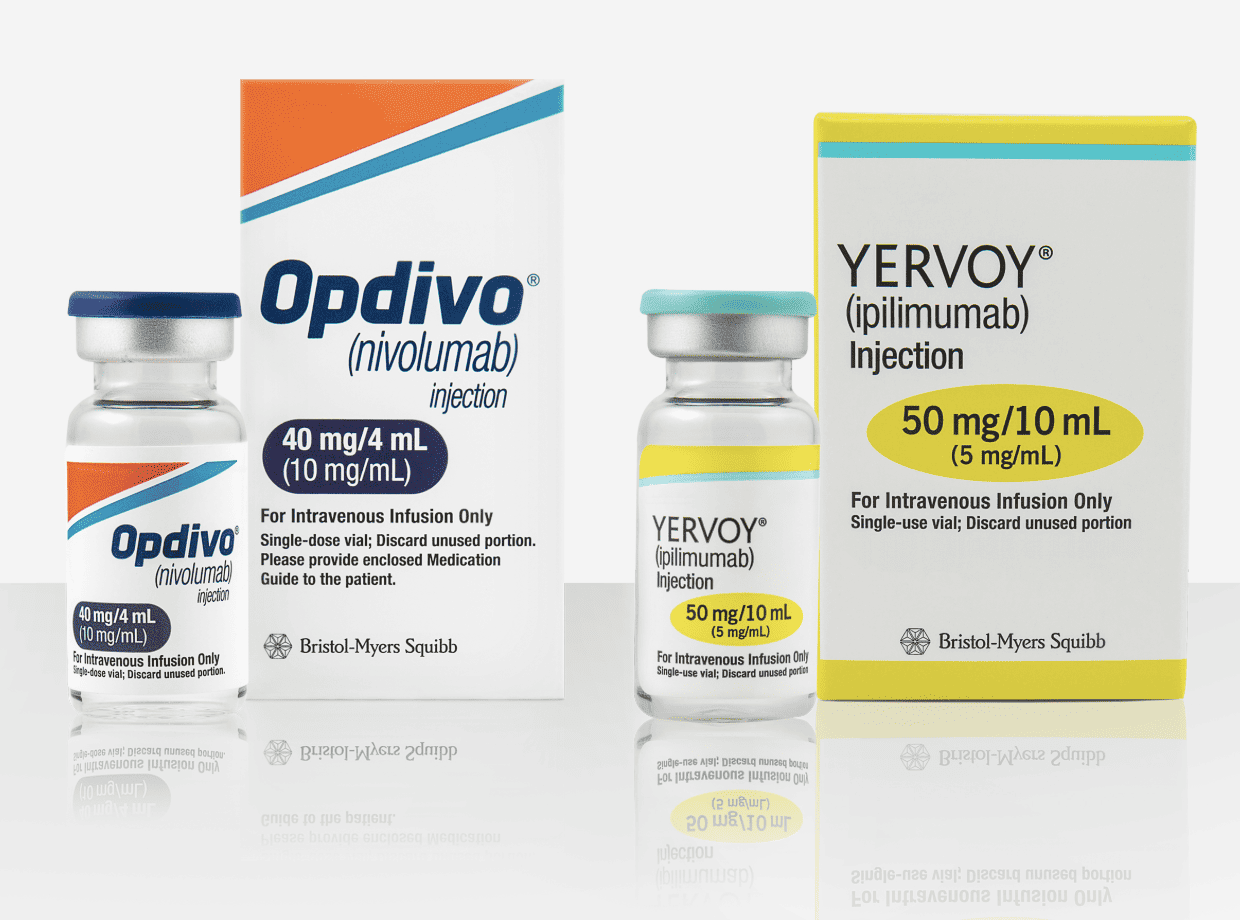
CheckMate 9LA was a global, randomized, open-label phase 3 study that enrolled 719 treatment-naive adults with stage IV or recurrent NSCLC without sensitizing EGFR or ALK alterations. Patients were randomly assigned 1:1 to receive either nivolumab (360 mg every 3 weeks) plus ipilimumab (1 mg/kg every 6 weeks) with 2 cycles of platinum-doublet chemotherapy, or chemotherapy alone for 4 cycles.3 This combined 2 agents with distinct but complementary mechanisms of action: nivolumab, which inhibits PD-1 activity, and ipilimumab, which inhibits CTLA-4 activity. Patients could receive immunotherapy for up to 2 years, and those with nonsquamous NSCLC in the chemotherapy arm were eligible for optional pemetrexed maintenance.
The first results for Checkmate 9LA were published in February 2021 in The Lancet Oncology.4 Findings from a preplanned interim analysis showed that after a median follow-up of 13.2 months, patients in the dual-immunotherapy arm had a 34% OS benefit compared with those receiving chemotherapy only.
Data at 6 Years Show Sustained Long-Term Benefit
At a median follow-up of 75.8 months, the HR for OS was 0.74(95% CI, 0.63-0.87), with 6-year OS rates of 16% vs 10%.1 The survival benefit was consistent across most prespecified subgroups and appeared to be maintained regardless of tumor histology. In patients with squamous NSCLC, 6-year OS rates were 14% with the combination vs 5% with chemotherapy (HR, 0.65; 95% CI, 0.49-0.85). For nonsquamous histology, the results were 17% vs 12% (HR, 0.79; 95% CI, 0.65-0.96). The greater magnitude of benefit observed in squamous NSCLC is noteworthy, as these patients typically have limited treatment options and poorer prognoses.5
Encouraging Results Seen in PD-L1–Negative Patients
Clinically significant findings were also seen among patients with tumor PD-L1 expression below 1%—a population that has historically represented a major therapeutic challenge. These patients have tumors that don’t strongly express the PD-L1 protein, making them less responsive to single-agent PD-1/PD-L1 inhibitors, which rely on “uncloaking” cancer cells for immune system recognition. Without targetable driver mutations, these patients have been left with chemotherapy combined with immunotherapy as a common strategy, though this approach has typically yielded limited long-term benefits.2
The 6-year findings showed that patients with PD-L1 expression of less than 1% had an OS rate of 20% compared with 7% for those treated with chemotherapy alone (HR, 0.64; 95% CI, 0.49-0.84), representing a nearly 3-fold difference in long-term survival. The median OS was 17.7 months vs 9.8 months, respectively, demonstrating both early and sustained benefit.1,4
For patients with PD-L1 expression of at least 1%, 6-year OS rates were 15% with the dual immunotherapy combination vs 10% with chemotherapy alone (HR, 0.75; 95% CI, 0.61-0.92), with a median OS of 15.8 months vs 10.9 months. Although the absolute benefit was smaller in this subgroup than in patients with PD-L1 expression of less than 1%, the combination regimen still demonstrated consistent efficacy across the PD-L1 expression spectrum.
“The addition of a short course of chemotherapy to nivolumab plus ipilimumab appeared to provide greater response benefit [than] nivolumab plus ipilimumab,” the authors note in their discussion of the results. “In the phase 3 CheckMate 227 study,6 [overall response rates] with nivolumab plus ipilimumab were 27% in patients with tumor PD-L1 < 1% and 36% in patients with tumor PD-L1 ≥1% compared with 31% and 43% with nivolumab plus ipilimumab with chemotherapy in the respective tumor PD-L1 expression subgroups in CheckMate 9LA.”1
The authors further note, “Long-term survival outcomes were similar between the 2 immunotherapy-based regimens, however, with 6-year OS rates of 16% and 22% with nivolumab plus ipilimumab in the tumor PD-L1 <1% and PD-L1 ≥1% subgroups…of CheckMate 227, respectively, compared with 20% and 15%, respectively, with nivolumab plus ipilimumab with chemotherapy in the current study.”1
“By simultaneously targeting both PD-1 and CTLA-4 pathways, this dual immunotherapy approach may activate different aspects of the immune response, providing benefit even when PD-L1 expression is minimal,” they conclude.1
Duration of Response: Long-Term Durable Responses
The durability of responses with the combination regimen was noteworthy. Among all responders, 19% maintained ongoing responses at 6 years with nivolumab plus ipilimumab with chemotherapy, despite protocol-mandated treatment cessation at 2 years. All patients in the chemotherapy arm had either stopped responding or had been censored before this time point.
In patients with PD-L1 expression of less than 1%, the 6-year duration of response (DOR) rate was 25% with the combination vs 0% with chemotherapy. The median DOR was 17.5 months vs 4.3 months, respectively.1 For patients with PD-L1 expression of 1% or greater, the 6-year DOR rate was 16% with the combination vs not available for chemotherapy, with a median DOR of 11.8 months vs 5.6 months.1
These findings suggest that when patients respond to nivolumab plus ipilimumab with chemotherapy, a substantial proportion experience durable benefit that persists long after treatment discontinuation—a hallmark of effective immunotherapy that may reflect lasting immunological memory.
Progression-Free Survival and Somatic Mutations
In addition, 6-year progression-free survival (PFS) rates favored the combination, at 9% vs 3% (HR, 0.70; 95% CI, 0.59-0.82). Exploratory analyses examining outcomes by somatic mutation status showed trends toward improved OS with nivolumab plus ipilimumab with chemotherapy regardless of KRAS, STK11, KEAP1, or TP53 mutation status. Among 6-year survivors with mutation-evaluable tissue, 32% had KRAS-mutant NSCLC, 37% had STK11-mutant disease, and 61% had TP53-mutant disease, suggesting that harboring these traditionally poor-prognosis mutations did not preclude long-term benefit from the combination regimen.
The safety profile was consistent with that of previous analyses, with no new treatment-related adverse events or safety signals. Among 61 patients who discontinued all components of the nivolumab plus ipilimumab with chemotherapy regimen due to treatment-related adverse events, the 6-year OS rate was 34%, which was substantially higher than that of the overall population. This finding indicates that early discontinuation due to toxicity did not adversely affect long-term outcomes; the authors said that effective immune responses may have already been established.
Cross-Trial Comparisons and Clinical Implications
Although the authors caution about the limitations of cross-trial comparisons, due to differences in study design and patient populations, they point out numerical advantages in outcomes for Checkmate 9LA compared with other phase 3 trials: the POSEIDON trial, evaluating durvalumab plus tremelimumab with chemotherapy,7 and the KEYNOTE trials studying pembrolizumab plus chemotherapy.8-10 Among other data, the authors highlight the better outcomes in OS for patients who were PD-L1 negative:
- CheckMate 9LA demonstrated a greater benefit than POSEIDON (NCT03164616) with a 6-year OS rate of 20% vs 7% for nivolumab plus ipilimumab with chemotherapy, compared with a 5-year OS rate of 6% vs 4% for durvalumab plus tremelimumab with chemotherapy in POSEIDON.7
- In KEYNOTE-407 (NCT02775435;squamous NSCLC),8 5-year OS rates in patients with PD-L1 less than 1% were 11% vs 13% in the 2 arms.
- In KEYNOTE-189 (NCT02578680;nonsquamous NSCLC),9 the 5-year OS rates were 10% vs 5%, and in a pooled analysis of both KEYNOTE trials, the rates were 12% vs 9%.10
The authors assert that the 6-year CheckMate 9LA data establish nivolumab plus ipilimumab with chemotherapy as a highly effective standard-of-care option for first-line treatment of metastatic NSCLC. The regimen’s ability to deliver durable benefits across patient subgroups, particularly in populations with PD-L1 levels less than1% and squamous histology, which have historically had poor outcomes, represents a significant therapeutic advance.
“In particular,” they write, “the long-term DOR associated with this regimen highlights the durability of the clinical benefit gained by using this combination regimen of dual immune checkpoint inhibition and chemotherapy. These results further support nivolumab plus ipilimumab with chemotherapy as an efficacious standard-of-care first-line treatment option for patients with metastatic NSCLC.”
References
- Carbone DP, Ciuleanu TE, Cobo M, et al. Nivolumab plus ipilimumab with chemotherapy as first-line treatment of patients with metastatic non-small-cell lung cancer: final, 6-year outcomes from CheckMate 9LA. ESMO Open. 2025;10(6):105123. doi:10.1016/j.esmoop.2025.105123
- Gemelli M, Cortinovis C,Carola G, et al. Efficacy of immune checkpoint inhibitors (ICIs) in PD-L1 negative non-small cell lung cancer (NSCLC) – a meta-analysis based on reconstructed individual participant data. Lung Cancer. 2025;205:108621. doi:10.1016/j.lungcan.2025.108621
- A study of nivolumab and ipilimumab combined with chemotherapy compared to chemotherapy alone in first line NSCLC (CheckMate 9LA). ClinicalTrials.gov. Updated December 12, 2024. Accessed December 10, 2025. https://clinicaltrials.gov/study/NCT03215706
- Paz-Ares L, Ciuleanu TE, Cobo M, et al. First-line nivolumab plus ipilimumab combined with two cycles of chemotherapy in patients with non-small-cell lung cancer (CheckMate 9LA): an international, randomised, open-label, phase 3 trial. Lancet Oncol. 2021;22(2):198-221. doi:10.1016/S1470-2045(20)30641-0
- Santos ES, Rodriguez E. Treatment considerations for patients with advanced squamous cell carcinoma of the lung. Clin Lung Cancer. 2022;23(6):457-466. doi:10.1016/j.cllc.2022.06.002
- Brahmer JR, Lee JS, Ciuleanu TE, et al. Five-year survival outcomes with nivolumab plus ipilimumab versus chemotherapy as first-line treatment for metastatic non-small cell lung cancer in CheckMate 227.J Clin Oncol. 2023;41(6):1200-1212. doi:10.1200/JCO.22.01503
- Peters S, Cho BC, Luft AV, et al. Durvalumab with or without tremelimumab in combination with chemotherapy in first-line metastatic NSCLC: five-year overall survival outcomes from the phase 3 POSEIDON trial. J Thorac Oncol. 2025;20(1):76-93. doi:10.1016/j.jtho.2024.09.1381
- Novello S, Kowalski DM, Luft A, et al. Pembrolizumab plus chemotherapy in squamous nonsmall-cell lung cancer: 5-year update of the phase III KEYNOTE-407 study. J Clin Oncol. 2023;41:1999-2006. doi:10.1200/JCO.22.01990
- Garassino MC, Gadgeel S, Speranza G, et al. Pembrolizumab plus pemetrexed and platinum in nonsquamous non–small-cell lung cancer: 5-year outcomes from the phase 3 KEYNOTE-189 study. J Clin Oncol. 2023;41(11):1992-1998. doi:10.1200/JCO.22.01989
- Gadgeel SM, Rodríguez-Abreu D, Halmos B, et al. Pembrolizumab plus chemotherapy for metastatic NSCLC with programmed cell death ligand 1 tumor proportion score less than 1%: pooled analysis of outcomes after 5 years of follow-up. J Thorac Oncol. 2024;19(8):1228-1241. doi:10.1016/j.jtho.2024.04.011

